Showing posts with label history. Show all posts
Showing posts with label history. Show all posts
Thursday, January 19, 2012
Rekindling historical memory: Gandesa
A note I wrote to friends last month ended up in "The Volunteer," the journal of the Abraham Lincoln Brigade Archives.


Thursday, January 20, 2011
Los Migueletes
I stepped away from posting on this blog more than a year ago, as I got serious about completing the M.A. thesis I was working on. I am happy to report that it is finished.
"Los Migueletes: Catalan Soldiers and the Negotiation of Identities and Power in Eighteenth-Century Spain and New Spain" is now housed in the library of the University of California, Santa Barbara, and I have posted an electronic copy online, at http://losmigueletes.blogspot.com.
I am grateful for all the support that friends, family, and colleagues have offered the last few years, and I welcome comments about the work.
"Los Migueletes: Catalan Soldiers and the Negotiation of Identities and Power in Eighteenth-Century Spain and New Spain" is now housed in the library of the University of California, Santa Barbara, and I have posted an electronic copy online, at http://losmigueletes.blogspot.com.
I am grateful for all the support that friends, family, and colleagues have offered the last few years, and I welcome comments about the work.
Thursday, October 08, 2009
Ertugrul Osman, Last Grandson of an Ottoman Emperor, Dead at 97

I remember being fascinated by "The Last Emperor," the story of China's sovereign who was sent to a "re-education camp" after the revolution and ended up a humble gardener. I just learned of the recent passing of a similar historical figure: Ertugrul Osman, the man who might have been the Ottoman Sultan if not for the fall of the empire and the rise of a new republic. He spent most of his life in exile, in Manhattan, apparently a humble man resigned to the tricks of fate. I can't help but scratch my head and ask, "what if?"
Click the headline to read an intriguing obituary.
(Thanks for the email about this, Mom!)
Wednesday, May 20, 2009
How to make or break a Depression

"An economy should be set up like a hybrid engine in a car. You have the big, private engine and the smaller public engine, and the private engine turns along and does most of the driving, and it works most of the time. But in certain times, you need that hybrid engine to kick in and take over as the private engine falters. That’s key. That’s bottom line economic understanding."
Comments from Jim Gregory, a history professor I studied with while an undergraduate at the University of Washington. Read the rest of the interview in Real Change News.
Monday, May 18, 2009
History vs. heritage
History seeks to convince by truth, and succumbs to falsehood. Heritage exaggerates and omits, candidly invents and frankly forgets ... Heritage everywhere not only tolerates but thrives on historical error. Falsified legacies are integral to group identity and uniqueness."
--David Lowenthal, as quoted by A. Katie Harris in From Muslim to Christian Granada. Inventing a City's Past in Early Modern Spain (2007), p. xv.
--David Lowenthal, as quoted by A. Katie Harris in From Muslim to Christian Granada. Inventing a City's Past in Early Modern Spain (2007), p. xv.
Monday, May 11, 2009
Jack Kerouac slept here

When I was 19 and 20, living in San Luis Obispo, I learned that Jack Kerouac worked a brief stint in the trainyards there in 1953, sleeping in a hotel a stone's throw from the railroad.
At the time I was attending community college, working in a bookstore, and cultivating a fascination for the Beats. I emulated my heroes every chance I got, hopping freight trains to Oakland, wandering high or just ecstatic through San Francisco’s streets, hitch-hiking to Big Sur to camp by the river and meet wide-eyed eccentrics along the highway. I imagined that the hotel Kerouac stayed in was an earlier incarnation of "the Establishment," the funky 19-bedroom shared house that I called home, in the railroad district.
These days, I ride trains with an Amtrak ticket in hand and my interest in Kerouac and Co. has waned. Even so, I have often daydreamed about researching his time in San Luis, hoping to prove that the place he stayed was none other than the big green home of dreamers and beautiful souls at the corner of Santa Barbara and Leff Streets.
Turns out, my hunch was right...
Off the road
Jack Kerouac slept here
BY KYLIE MENDONCA, New Times
Monday, March 09, 2009

Tuesday, March 03, 2009
the immigration "problem"
"To Benjamin Franklin the prospect that the Germans 'will soon ... out number us' was one full of alarm. Their children didn't seem to learn English; they read imported German books and a German newspaper; interpreters were now needed in some courts. The very "Signs in the our Streets have inscriptions in both languages,' he noted warily, 'and in some places only in German.'"
Sound familiar? No one seems to worry about German-speaking immigrants these days, because in time, of course, they learned English -- just as today's immigrants to the U.S. will do.
- from Peter Silver, Our Savage Neighbors: How Indian War Transformed Early America, (New York: W.W. Norton, 2008), p. 13.

Sound familiar? No one seems to worry about German-speaking immigrants these days, because in time, of course, they learned English -- just as today's immigrants to the U.S. will do.
- from Peter Silver, Our Savage Neighbors: How Indian War Transformed Early America, (New York: W.W. Norton, 2008), p. 13.
Monday, January 05, 2009
A Turkish 'I apologize' campaign to Armenians
The fate of Armenians in 1915 remains taboo in Turkey, but some intellectuals are taking action.
By Esra Özyürek
January 5, 2009
Los Angeles Times
Two hundred Turkish intellectuals last month launched an Internet signature campaign for an apology to Armenians for the 1915 massacres. "My conscience does not accept the insensitivity showed to and the denial of the Great Catastrophe that the Armenians were subjected to in 1915," the brief statement reads. "I reject this injustice and for my share, I empathize with the feelings and pain of my Armenian brothers and sisters. I apologize to them."
Click here to see rest of article
By Esra Özyürek
January 5, 2009
Los Angeles Times
Two hundred Turkish intellectuals last month launched an Internet signature campaign for an apology to Armenians for the 1915 massacres. "My conscience does not accept the insensitivity showed to and the denial of the Great Catastrophe that the Armenians were subjected to in 1915," the brief statement reads. "I reject this injustice and for my share, I empathize with the feelings and pain of my Armenian brothers and sisters. I apologize to them."
Click here to see rest of article
Wednesday, December 10, 2008

Sunday, November 30, 2008
Happy November 30!
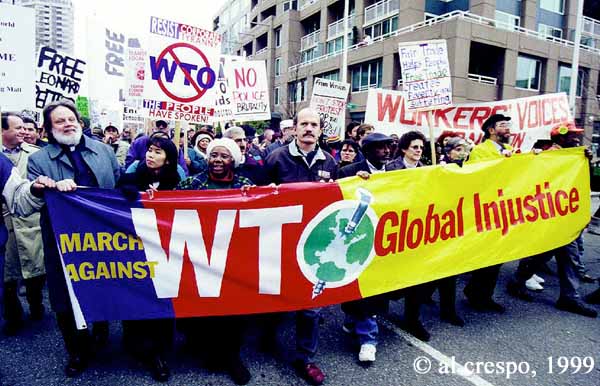
Seattle WTO Shutdown 9 Year Anniversary: 5 Lessons for Today
by David Solnit
"What lessons can we learn from the shutdown of the 1999 WTO Ministerial in Seattle 9 years ago today and from the last decade and a half of global justice organizing as we face today's major crises under an Obama Administration? This was the question a group of organizers from different parts of the last decades of global justice organizing responded to last week at a forum in New York City put together by Deep Dish TV, an independent video/media pioneer. Here are my thoughts..."
Click the link above to read David's comments on social movements, the WTO, the Obama Administration, and five organizing lessons:
1) UPROOT THE SYSTEM
2) ORGANIZE STRATEGICALLY
3) PEOPLE POWER
4) EXPERIMENT IN THE LABORATORY OF RESISTANCE
5) TELL STORIES
Photo by Al Crespo, from wtohistory.org; article from CommonDreams.org.
Monday, November 10, 2008
whose heroes?
My friend Gus, a great lover of history and a retired Lt. Colonel of the U.S. Marines, wrote the following on a recent trip to Mexico City. Every time he travels, which is often, he writes travelogues full of history and wonder.
Chapultepec Castle, site of the battle during the Mexican-American War in 1847. I am a little uncomfortable here. This is a sensitive site for Mexicans. On Sept 12-13, General Winfield Scott took the castle from General Santa Anna in a bloody battle that has been central to Mexican-American relations ever since.
Many non-combatant Mexicans were killed in the battle, as were six young teenage cadets from the military academy in the castle. Five of those cadets died in the battle, and the sixth wrapped himself in a Mexican flag and jumped to his death from the castle ramparts to avoid capture. The six are immortalized as the "Ninos (Children) Heroes" in a colossal memorial at the foot of the castle hill.
The battle played a significant role in US history also. "From the Halls of Montezuma", the opening lines of the Marine Corps Hymn, originate from this battle. The red stripe on Marine Corps dress blue uniform trousers commemorates this victory. [I don´t know if this is true, but I have heard that the US Marines at the embassy in Mexico City are not to wear their dress blue trousers for that reason.] Robert E. Lee, George Pickett and Ulysses S. Grant were all participants in the battle.
Chapultepec Castle, site of the battle during the Mexican-American War in 1847. I am a little uncomfortable here. This is a sensitive site for Mexicans. On Sept 12-13, General Winfield Scott took the castle from General Santa Anna in a bloody battle that has been central to Mexican-American relations ever since.
Many non-combatant Mexicans were killed in the battle, as were six young teenage cadets from the military academy in the castle. Five of those cadets died in the battle, and the sixth wrapped himself in a Mexican flag and jumped to his death from the castle ramparts to avoid capture. The six are immortalized as the "Ninos (Children) Heroes" in a colossal memorial at the foot of the castle hill.
The battle played a significant role in US history also. "From the Halls of Montezuma", the opening lines of the Marine Corps Hymn, originate from this battle. The red stripe on Marine Corps dress blue uniform trousers commemorates this victory. [I don´t know if this is true, but I have heard that the US Marines at the embassy in Mexico City are not to wear their dress blue trousers for that reason.] Robert E. Lee, George Pickett and Ulysses S. Grant were all participants in the battle.
Wednesday, October 15, 2008
quotes from historian Marc Bloch
There is no waste more criminal than that of erudition running ... in neutral gear.
To plumb the consciousness of another person, separate from us by the interval of generations, we must virtually lay aside our own ego, whereas, to say what we think, we need only to remain ourselves. This is a less arduous endeavor.
It is so easy to denounce. We are never sufficiently understanding.
Interestingly, it seems to me that the last two quotes apply not only to the craft of history, as the author intended, but to interpersonal relations.
Taken from The Historian's Craft, Vintage Books, 1953, pages 86, 141, and 143.

PS For whatever it's worth, this guy looks a lot like my grandfather.
To plumb the consciousness of another person, separate from us by the interval of generations, we must virtually lay aside our own ego, whereas, to say what we think, we need only to remain ourselves. This is a less arduous endeavor.
It is so easy to denounce. We are never sufficiently understanding.
Interestingly, it seems to me that the last two quotes apply not only to the craft of history, as the author intended, but to interpersonal relations.
Taken from The Historian's Craft, Vintage Books, 1953, pages 86, 141, and 143.
PS For whatever it's worth, this guy looks a lot like my grandfather.
Tuesday, September 16, 2008
Seattle WTO People's History Project

The Battle for the Story of Seattle: A Call to Social Movements to Reclaim Our History
"Until the lions have their own historians, tales of hunting will always glorify the hunter." —African Proverb
A major motion picture called "Battle in Seattle" is being released now in cities across the country. The movie is a docu-drama – a fictional story based on real events — that features extensive archival footage. It may shape what most people in the US and around the world think happened for decades to come—unless we speak up. We call for social movements to take action: to reclaim our history, our stories, and our future.
The story of popular resistance to the World Trade Organization (WTO) in Seattle in 1999 is a story of how people power can change the world. It is a dangerous example for the global elite, and a powerful one for movements.
For eight years, the US corporate media, global elites, and their police have been twisting and marginalizing the truth, in order to invent their own story of Seattle 1999 and the stories of social movements' resistance and victories. These lies and revisions of history have been used in an attempt to criminalize and repress our protests, movements, and mobilizations.
The movie will be released on the eighth anniversary of the 1999 Seattle anti-WTO uprising and shutdown. It was written by a well-meaning actor-director, but is unlikely to reflect the motives, experience, or thinking of the movements behind the shutdown of the WTO. The potential is high and the possibilities are infinite to interrupt this narrative and claim the history that we helped create.
"The struggle of people against power is the struggle of memory against forgetting."
—Milan Kundera
It's time that we in the social movements tell our own stories, reclaim our own histories, and publicly fight damaging myths of our movements past and present. We must intervene in the public understanding of what happened, what is happening, and what it all means. Stories are how we understand the world and thus shape the future—they are part of our fight against corporate power, empire, war, and social and environmental injustice and for the alternatives that will make a better world.
The real story of Seattle 1999 is of tens of thousands of people rising up, taking direct action, and changing history; standing up to corporations and governments and winning; joining with movements around the world in our common struggle against the WTO.
"When it's truly alive, memory doesn't contemplate history, it invites us to make it."
—Eduardo Galeano, Upside Down: a primer for the looking-glass world
Let's link the 1999 resistance to the WTO in Seattle and globally with building support for today's 2007 resistance that is continuing the fight for global justice on many fronts; against war and occupation for environmental and climate justice; for workers, immigrants, women, and farmers rights, etc. We call for commemorations, public events, performances, media, interventions, interruptions, educational events, performances, screenings, gatherings, and celebrations.
Saturday, September 06, 2008
The Battle for Reality

The Hollywood movie "Battle in Seattle" is opening in select theaters around the country. This article in Yes! Magazine is very helpful in understanding the film's context, achievements and flaws. It was written by David Solnit, an organizer who was a key player in forming the Direct Action Network that shut down the World Trade Organization meetings in 1999.
Also of note are the film's official webpage and realbattleinseattle.org, a people's history project David and others have been working on, and the WTO History Project I worked on a few years ago at the UW.
Wednesday, July 23, 2008
Father's WWII stories live on in son's e-mails

from the Oregonian (via Seattle Times) ...
"Michael van der Hout, 51, a legal services assistant at a Portland law firm, sorts through his father's memorabilia to craft a story about his family's history. He sends stories to 200 people, many of them strangers, across the United States, Canada and Europe."
photo by Olivia Bucks, story by Tom Hallman, Jr.
[click on headline for the story]
Friday, November 09, 2007
Want to read about my big project? Click here.

For the last few years, I've been researching the roots of the Free Company of Catalonian Volunteers, a unit of the Spanish army in the 1700's that was instrumental in the colonization of what we now call California. I've been cooking up a plan to write a historical novel about them and the Chumash peoples they encountered in the land where I grew up, illustrating the human costs of imperial conquest. This week I updated and revised a description of the project to share with foundations, colleagues and friends, and I have just posted it online. I call the project "At the Edge of Empire."
[Update Jan. 2011: This project evolved into a master's thesis, now completed and online at http://losmigueletes.blogspot.com.]
Sunday, June 03, 2007
The art of the possible
What happened in a small town in Andalucía, with many homeless families and an unemployment rate of 70 percent, when people voted in a socialist mayor and town council? They built homes, soccer fields, swimming pools and cooperatives to process local wine, olives, beans, and peppers, and now they have to bring in workers from elsewhere ...
Read about it in "El imbatible alcalde de Marinaleda," by Juan Jesús Aznárez, El Pais May 17, 2007.
Read about it in "El imbatible alcalde de Marinaleda," by Juan Jesús Aznárez, El Pais May 17, 2007.
Wednesday, February 28, 2007
History lesson
[from the Turkish daily Hurriyet]
“If we had all been able to say, ‘We are all Jewish’, there would have been no Hitler”
Speaking at a conference about coming to term with the past, Aleida Assman of Konstanz University in Germany said that the lessons and spirit of Hrant Dink, the Turkish-Armenian journalist who was felled by a sniper’s bullet last month, lived on.
“We still hear his voice, and aim for his beliefs to continue to exist,” she told attendees at the “From the Burden of the Past to Societal Peace and Democracy” international conference at Bilgi University in Istanbul.
Drawing attention to the “We are all Armenian” slogan carried by those attending Hrant Dink’s funeral in Istanbul, Assman said that “synagogues, homes and goods belonging to the Jewish minority were ransacked in Germany in 1938. If we had been able to say, “We are all Jewish,” would Hitler have been able to do this?”
“If we had all been able to say, ‘We are all Jewish’, there would have been no Hitler”
Speaking at a conference about coming to term with the past, Aleida Assman of Konstanz University in Germany said that the lessons and spirit of Hrant Dink, the Turkish-Armenian journalist who was felled by a sniper’s bullet last month, lived on.
“We still hear his voice, and aim for his beliefs to continue to exist,” she told attendees at the “From the Burden of the Past to Societal Peace and Democracy” international conference at Bilgi University in Istanbul.
Drawing attention to the “We are all Armenian” slogan carried by those attending Hrant Dink’s funeral in Istanbul, Assman said that “synagogues, homes and goods belonging to the Jewish minority were ransacked in Germany in 1938. If we had been able to say, “We are all Jewish,” would Hitler have been able to do this?”
Sunday, July 30, 2006
A bit of Truth and Reconciliation
The Guardian: Spain finally attempts to lay ghosts of the Franco era
Spain's Socialist government yesterday proposed measures to help families of the victims of General Franco's dictatorship dig up mass graves, but refused to annul tens of thousands of summary death sentences handed down by his regime.
A long-awaited proposed law, to compensate victims of the Spanish civil war and the 36-year dictatorship that followed it, also bans the far right from holding rallies at Franco's grave in the Valley of the Fallen outside Madrid ...
Spain's Socialist government yesterday proposed measures to help families of the victims of General Franco's dictatorship dig up mass graves, but refused to annul tens of thousands of summary death sentences handed down by his regime.
A long-awaited proposed law, to compensate victims of the Spanish civil war and the 36-year dictatorship that followed it, also bans the far right from holding rallies at Franco's grave in the Valley of the Fallen outside Madrid ...
Subscribe to:
Posts (Atom)